
Mastering Crochet Abbreviations: Your Ultimate Stitch DecoderCrochet abbreviations guide
One of the most crucial aspects of crochet involves the ability to read crochet abbreviations. If the names of the stitches were to be written out instead of being abbreviated, people would probably give up crocheting from patterns, as they would be hard to read and very tedious. It would also make it difficult to repeat the project. Designers can write their patterns with abbreviations faster than in longhand. Whatever level you crochet on, or if you are a designer or enthusiast, this guide serves as both a beginner’s guide and a refresher for experienced hookers.
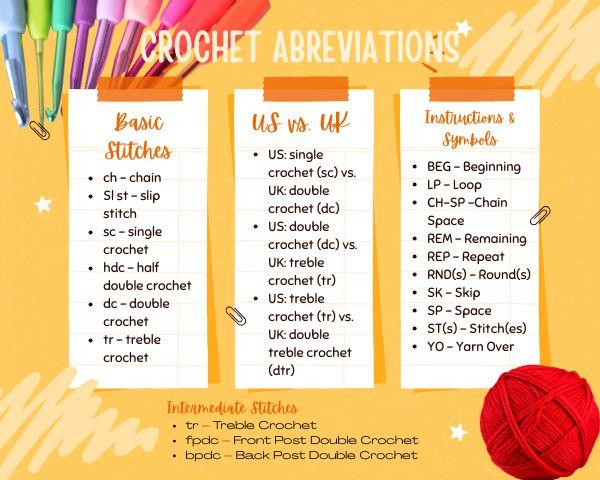
Basic Crochet Abbreviations
The most essential stitches, which form the foundation of all crochet stitches, comprise the basic crochet abbreviations. These are common terms found in beginner patterns.
- Examples:
- ch – chain
- Sl st – slip stitch
- sc – single crochet
- hdc – half double crochet
- dc – double crochet
- tr – treble crochet
Intermediate & Complex Stitches
Another set of crochet abbreviations indicates more advanced stitches, which are less frequently performed than the basic ones. Here are some terms used in textured or advanced patterns.
- Examples:
- tr – Treble Crochet
- fpdc – Front Post Double Crochet
- bpdc – Back Post Double Crochet
3. Pattern Instructions & Symbols
Abbreviations for pattern structure and repeats will also exist within your pattern directions. They tell you what to do with the basic and advanced stitches
- Examples:
- BEG – Beginning of the round or row.
- CH-SP – Chain space. This stitch is the space in the previous row created when one or more chain stitches were made. It is usually CH-n-SP, where n indicates the number of chains made to create the space.
- LP – Loop. A hook always has at least one loop; others are created by yarning over and pulling up another loop on the hook to form stitches.
- REM: Remaining. This abbreviation indicates the remaining stitches in a round or row.
- REP: Repeat. It is often combined with symbols. For example, REP from * means to repeat the part of the row or round written after the asterisk. Or (instructions) REP 4 times, meaning you must work the instructions between the brackets four additional times. (So you would follow the instruction the first time and then repeat it the indicated additional times)
- RND(s): Round(s). Used when crocheting in the round as opposed to rows.
- SK: Skip. You do not stitch in the indicated number of stitches when you skip a stitch. This technique often creates a chain space before working on the next stitch.
- SP: Space. A gap is made by working one or more chain stitches between other stitches.
- ST(S): Stitches. A crochet stitch is a basic unit of crochet. It is created by pulling a loop of yarn through another loop using a crochet hook. Different types of stitches create different textures and patterns in the finished fabric.
- YO: Yarn over is when you wrap your yarn around the hook to form a stitch
4. US vs. UK Crochet Terms
The US and the UK have differences in terminology, which make the abbreviations mean different things. Before starting a crochet project, make sure you determine which terms are being used for it. You can receive a different outcome for finished work as it relates to size and appearance if you fail to determine the difference in terms..
- Examples:
- US: single crochet (sc) vs. UK: double crochet (dc)
- US: double crochet (dc) vs. UK: treble crochet (tr)
- US: treble crochet (tr) vs. UK: double treble crochet (dtr)
Conclusion
Abbreviations are used in crochet patterns to make the instructions more concise and easier to read, and it’s important to remember that abbreviations will vary by region. Many charts exist online that you can print out and use as a reference. What do you think about crochet abbreviations and how they simplify your crochet projects or designs?


Leave a Reply